
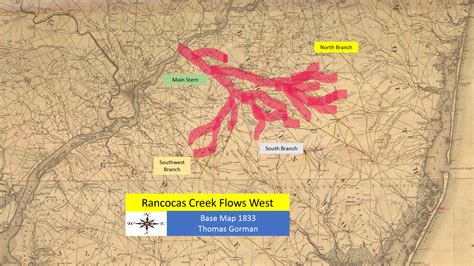
 One of the great assets of the Medford and Lumberton campuses of Medford Leas is that they are both situated along branches of the Rancocas Creek. We are intuitively drawn to our lakes and rivers and oceans, perhaps, whether consciously or subconsciously, recognizing water’s importance to life. Many native peoples around the world view their rivers and streams not just as vital to their lives, but as living entities in their own right.
The Rancocas Creek is long and meandering with three branches and many small tributaries arising in the Pinelands National Reserve. The creek’s North Branch (28miles long) begins just south of Fort Dix, flowing into Mirror Lake in northern Burlington County. The South Branch (22 miles long) starts near Chatsworth in the central part of the county. It receives the Southwest Branch (14 miles long) about 7 miles north of Medford. The two main branches merge near Rancocas State Park and flow together for 8 miles to the Delaware River.
The creek’s name references the native peoples for whom it was a source of sustenance and transportation. The Unami Tribe of the Lenape called the creek “Lenape-wihittuck,” meaning the rapid stream of the Lenape. Early settlers mapping the region called it “Rankokus” after the Unami tribal leader Ramcock (or Remcoke).
The Medford campus is located on the creek’s Southwest Branch. A significant portion of the eastern Red Trail on the Medford Campuses affords views of the creek. The southern portion of the trail follows along Sharp’s Run that feeds into the creek. In addition, the campus maintains a kayak and canoe launch along the Red Trail, allowing residents and their visitors to explore the creek on the water from Kirby’s Mill to Medford Village.
The Lumberton Campus is located on the Creek’s South Branch, and there the Rancocas Trail takes one down to creekside while the KayDee Trail leads one to a marsh near the creek. Maps of the trails on both campuses can be found on the Medford Leas website, under Barton Arboretum—Nature Preserve.
The creek’s presence on our campuses, contributes to the diversity of plant and wildlife we can observe. There is evidence of beaver activity along the creek on both campuses. A number of turtle species can be found in summer months. This past summer a female snapping turtle crawled up the banks near Woods Cottage and deposited her eggs in a flower bed. Great Blue Heron’s can be seen year round, and the cries of Kingfishers salt the summer air. The Canada Geese are ever present while a variety of ducks come and go with the seasons.
By Judy Austermiller