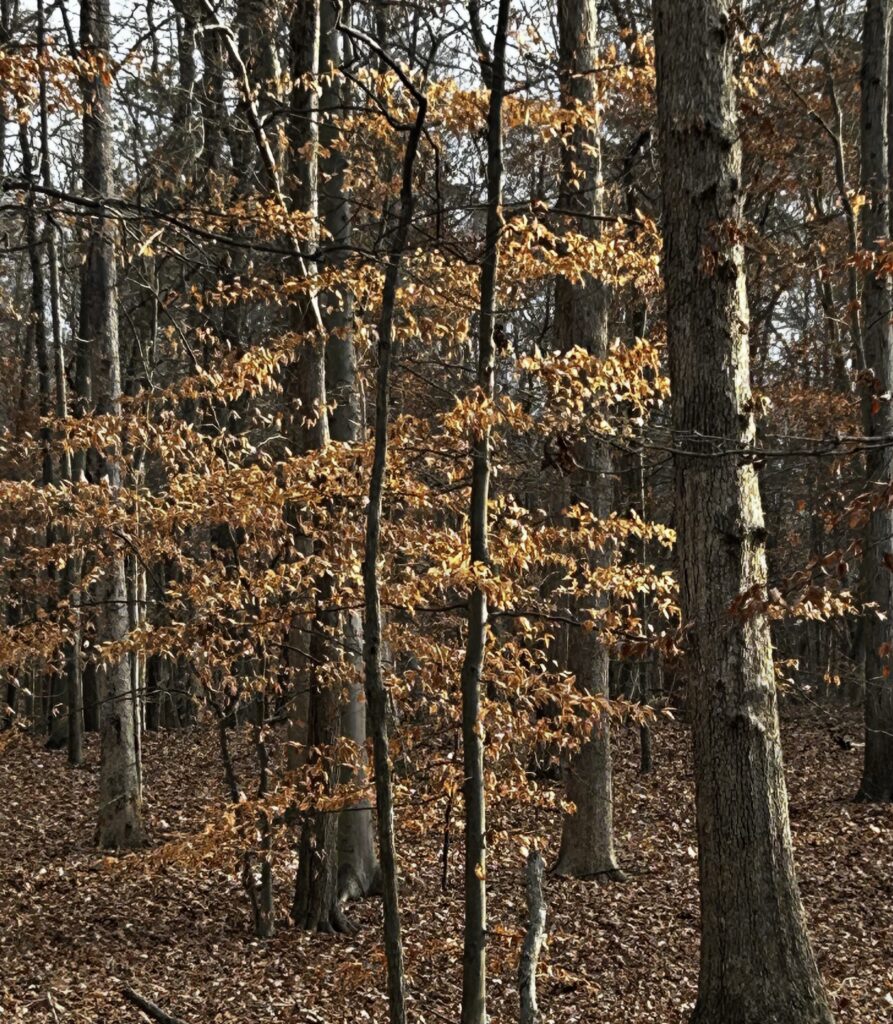
March 2026 – Marcescence
Have you noticed the grove of beech trees next to the Nature Center on the Medford Campus, and how the saplings keep their dry copper-colored leaves all winter? Another such grove is seen along Creek Road, across from the entrance to the Lumberton Campus. Marcescence is the botanical term for the retention of leaves after they have withered. The mechanism by which trees drop their leaves in autumn is called abcission, but in certain families of trees the process is delayed until spring. In our region, the families of trees that often retain leaves in winter include beeches, hornbeams, some oaks, some willows, and witch-hazels. All of these are represented in our Arboretum.
Science doesn’t have an explanation of this phenomenon, but there are many theories. Perhaps marcescence allows the conservation of nutrients by delaying their release into the soil until spring—a natural compost. Perhaps exposing the leaves to light all winter assists in the breakdown of leathery, tough leaves. Or maybe deer and moose don’t like to eat these dried leaves, so they leave the tender bud-bearing twigs alone.
Whatever the cause, marcescence provides us with much to appreciate. The superb gold and silver of beech saplings in the sun, the texture of crinkly oak leaves, and the sound of rustling in the winter wind—all these add to our enjoyment of the winter season.
— Laurie Larson