
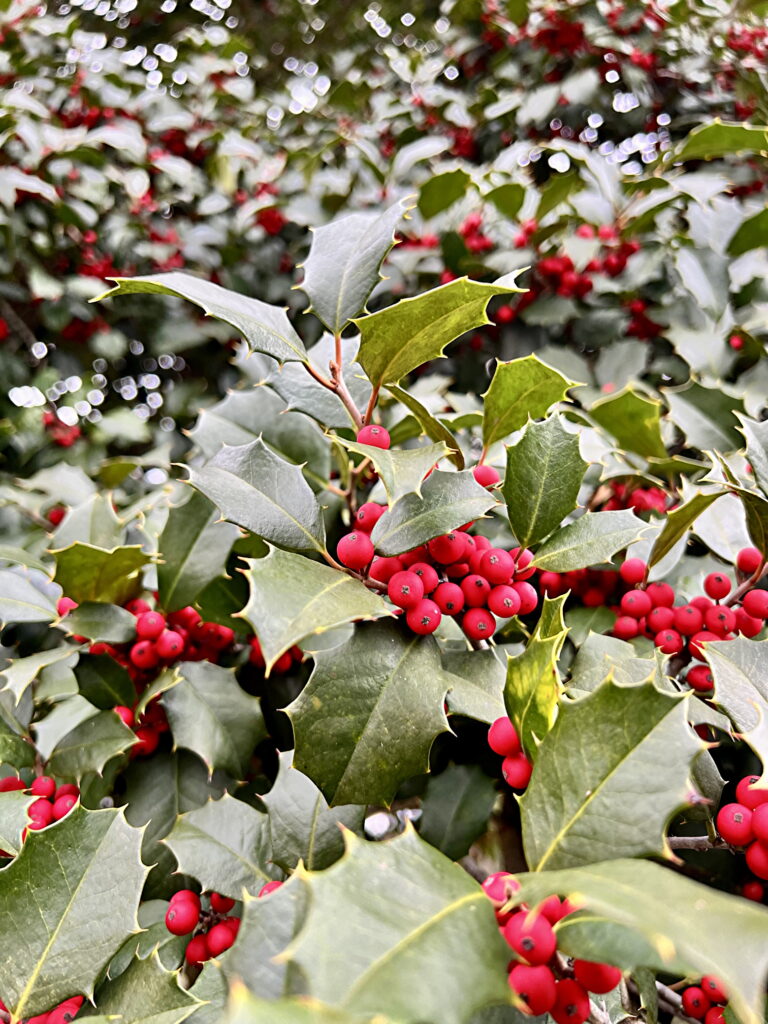
During the dark months of winter the hollies in our landscape shine. Two varieties of hollies are native to our ecoregion, the American holly (Ilex opaca) and winterberry holly (Ilex verticillata). Between the shiny leaves of the American holly and the bright red berries of both, they are the standouts in our winter landscape.
Our American holly is a tree that can grow to 60 feet in height. Medford Leas’ state champion American holly, located along the road into Medford Leas’ main parking lot, was measured several years ago at 53 feet. The wintergreen holly, on the other hand, is a shrub growing 6 to10 feet, and unlike the American holly it is deciduous, losing its leaves in winter. A good place to see both hollies is in Court 11 where the winterberry holly, in particular, is ablaze with red berries.
Holly berries are not the first choice food for most of our winter wildlife, but as winter progresses and other foods become scarce, these berries sustain a number of bird species and at times, even deer, squirrels and mice.
Hollies have separate male and female plants which explains why you may see hollies without berries. For the females to have berries, there needs to be a male tree nearby for fertilization. Within our arboretum, there is one holly that is an exception to this rule. Ilex Foster is a hybrid between the American holly and Cassine holly, a native of the southern U.S. and the Caribbean. Two of these hollies can be seen in the lawn surrounded by Courts 21-24. The Arboretum also contains cultivars of our native hollies such as the yellow-berried holly showing off in front of the Nature Center.
Hollies have long been associated with the winter holidays. For seven days beginning on the winter solstice, the Romans celebrated Saturnalia, honoring Saturn, god of agriculture, renewal and abundance. Holly wreaths adorned the doors of Roman homes and gifts were presented with small holly twigs tied to them. As Christianity spread, these practices were incorporated into celebrations of the new religion, spread throughout much of Europe, and we carry them forward today.
— Judy Austermiller